Your Sales Team Is Sitting on Your Best Growth Data


Most growing companies hit the same wall in sales. A few honest questions:
- Can you predict next quarter’s revenue within 10 percent, or is that forecast mostly hope?
- Do you know exactly where deals fall through in your pipeline, and why?
- If your best salesperson quit tomorrow, would the way they win walk out the door with them?
- Does everyone mean the same thing by a “qualified” lead? Or any other stage?
- Is your sales data clean enough that you’d trust AI to act on it? (…this is a fun one)
If a few of those stung, you’re in good company. Most of the businesses we see run sales on hustle, instinct, and a few people who keep the whole system in their heads. That works, right up until you try to scale it, plan around it, or hand it to someone new.
The missing piece
In the businesses we work with, the problem is rarely talent or effort. It’s the lack of a system. The way a company wins usually already exists. It just lives in a few people’s heads instead of somewhere it can be seen, measured, and repeated.
That’s what a growth engine fixes. Most businesses already own the raw material for one: the data, the process, the team’s hard-won instincts. Our job is to study what’s working, write it into a playbook, then automate it.
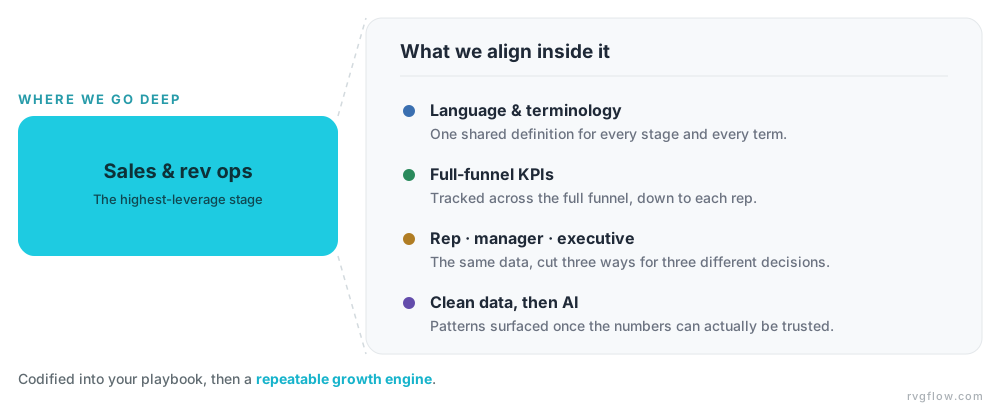
The deepest, highest-leverage part of that work is sales and rev ops. It’s where the best data is created, and where most of it quietly gets lost.
Sales isn’t the whole engine. Founder vision and old beliefs about “how big we can get” can stall it too. But sales is the part most companies underuse, and the part everything else reads from. Fix it and you turbocharge two things at once: how you sell, and how much you learn from every deal.
Here’s what we dig into:
Speak the same language
Ask three reps what “qualified” means and you’ll get three answers: a lead with a budget, anyone who picks up the phone, or whatever feels like it might close. Same word, three different bars. Any report built on that is built on noise.
Stages are worse, because stages drive the forecast. “Proposal sent” should mean a proposal was sent, received and being evaluated – not “I gave a verbal price” or “I sent it” (no receipt confirmation or follow-up).
So before we touch a dashboard, we pin down three things for every stage:
- What has to be true for a deal to be there
- What moves it to the next step
- Who logs it, and when
| Stage | A deal enters when… | It moves forward when… | Who logs it |
|---|---|---|---|
| Qualified | Need, budget, and a decision-maker are confirmed | A discovery call is booked | SDR / rep |
| Discovery | The call has happened and the pain is documented | A clear fit is agreed | Rep |
| Proposal | A written proposal has been sent | The buyer confirms they’re reviewing terms | Rep |
| Negotiation | Price and scope are being worked out | Both sides agree on the deal | Rep |
| Closed won | A signed agreement is in hand | n/a | Rep / ops |
Boring? Yes. But once everyone uses the same words, the numbers finally mean something. That’s the only data worth measuring or automating.
Measure the whole journey
Most teams only watch closed-won. That tells you the engine made money. It doesn’t tell you where it’s leaking.
Follow a lead the whole way instead: where it came from, how it qualified, which stages it moved through, how long it sat in each, who touched it. The leaks show up between the stages.
A team that turns 60% of leads into proposals but closes only 15% of them has a very different problem than the reverse. You’d never spot it from the bottom line.
And go down to the individual rep. A team average hides whether you’ve got a process problem or a people problem:
- One rep closing at 45% while the team sits at 20%? Copy what they do into the playbook.
- Someone stuck at 5%? That’s a coaching conversation, not a system rebuild.
The same numbers should mean different things to different people:
| Level | What they watch | Example KPIs | The decision it drives |
|---|---|---|---|
| Sales rep | Their own deals | Meetings booked, stage conversion, win rate, cycle time | Where to spend today’s hours |
| Manager | The team’s pipeline | Pipeline coverage, conversion by rep, stalled deals, forecast accuracy | Who to coach, which deals to inspect |
| Executive | The whole engine | Win rate, CAC, sales cycle, pipeline velocity, forecast reliability | Whether to hire, spend, or change the plan |
Give leaders a dashboard they trust
Executives don’t need forty metrics. They need the few that answer one question: can I trust this engine enough to plan around it? A good leadership dashboard reads in about thirty seconds.
| Metric | What it answers | Why it matters |
|---|---|---|
| Pipeline coverage | Do we have enough pipeline to hit the number? | Early warning before a miss, not after |
| Win rate | How often do we close what we work? | Efficiency, and a check on the forecast |
| Sales cycle length | How long from new lead to signed deal? | Cash flow and capacity planning |
| Customer acquisition cost | What does a new customer cost us? | Tells you if the growth is even profitable |
| Forecast accuracy | Can we believe the forecast? | Every plan built on a bad one is also bad |
| Net revenue retention | Are existing customers growing with us? | Growth that doesn’t depend on new logos |
Get those six honest and leadership can make real calls. Build them on loose data and they’re just confident guesses.
Bring in AI last
There’s huge pressure to point AI at sales and let it sort everything out. Lead scoring, deal-risk flags, forecasting. The tools are real, and they work, on clean data.
Most companies don’t have clean data. They have years of loose records, half-empty fields, and stages updated whenever someone remembered. Point AI at that and you get answers that look polished and are quietly wrong. That’s worse than no answer, because people believe them.
So the order matters:
- Align the team
- Clean up the language
- Define what good looks like at every level
- Then add AI
On a clean foundation, AI is a real multiplier. On a mess, it just makes the mess faster.
The takeaway
Sales is one part of your growth engine, but it’s the part sitting on your richest data. Get the words right, make the numbers honest, and the engine becomes something you can steer. Skip it, and you’ve just automated a guess.
Most companies won’t do the unglamorous part. That’s exactly why it’s an edge for the ones that do.